
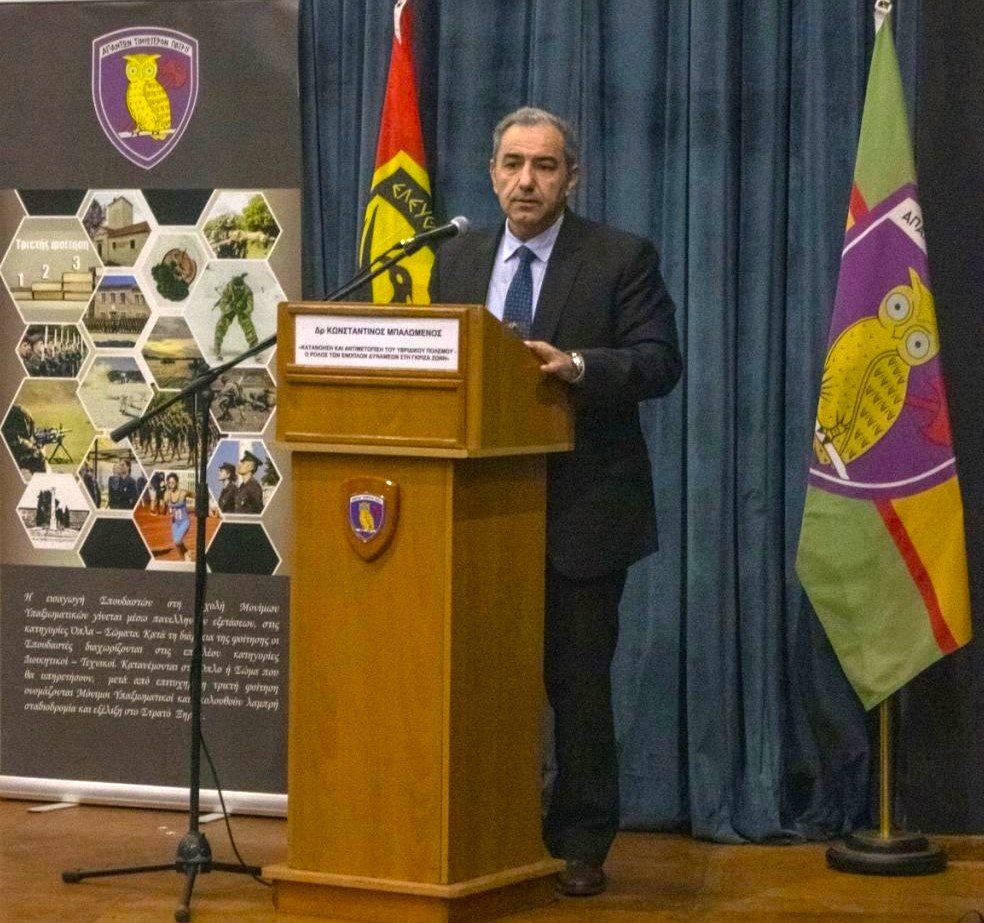
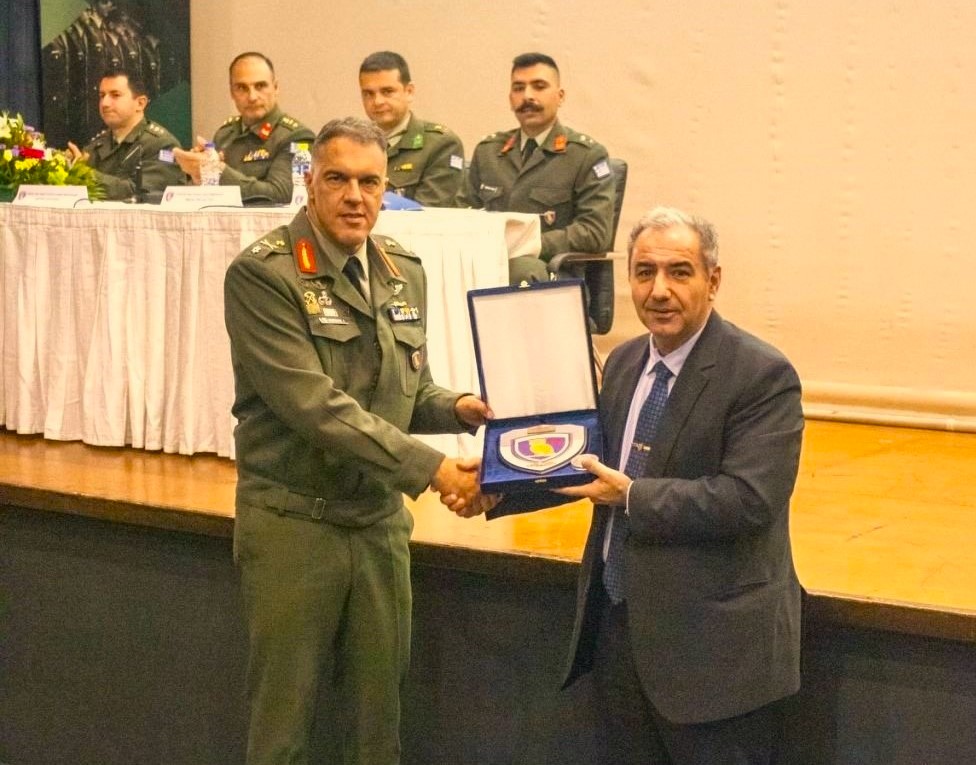
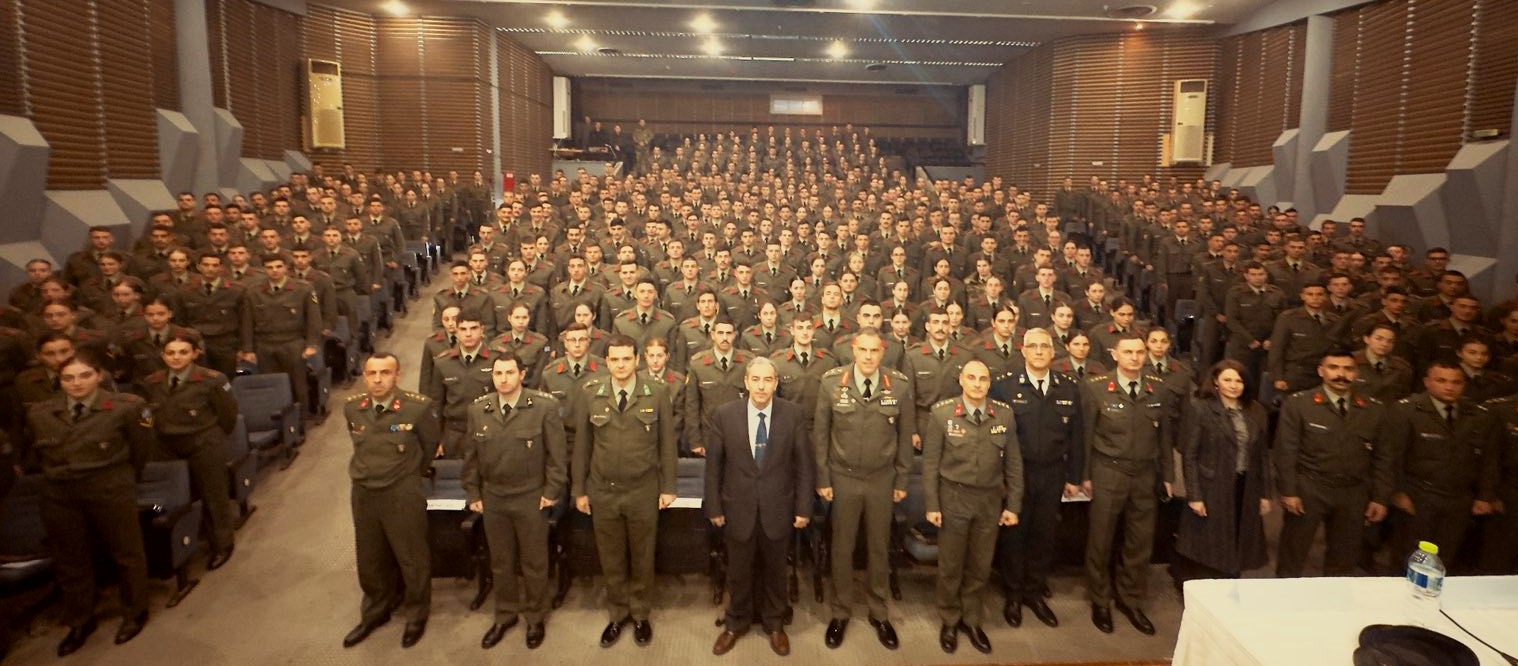
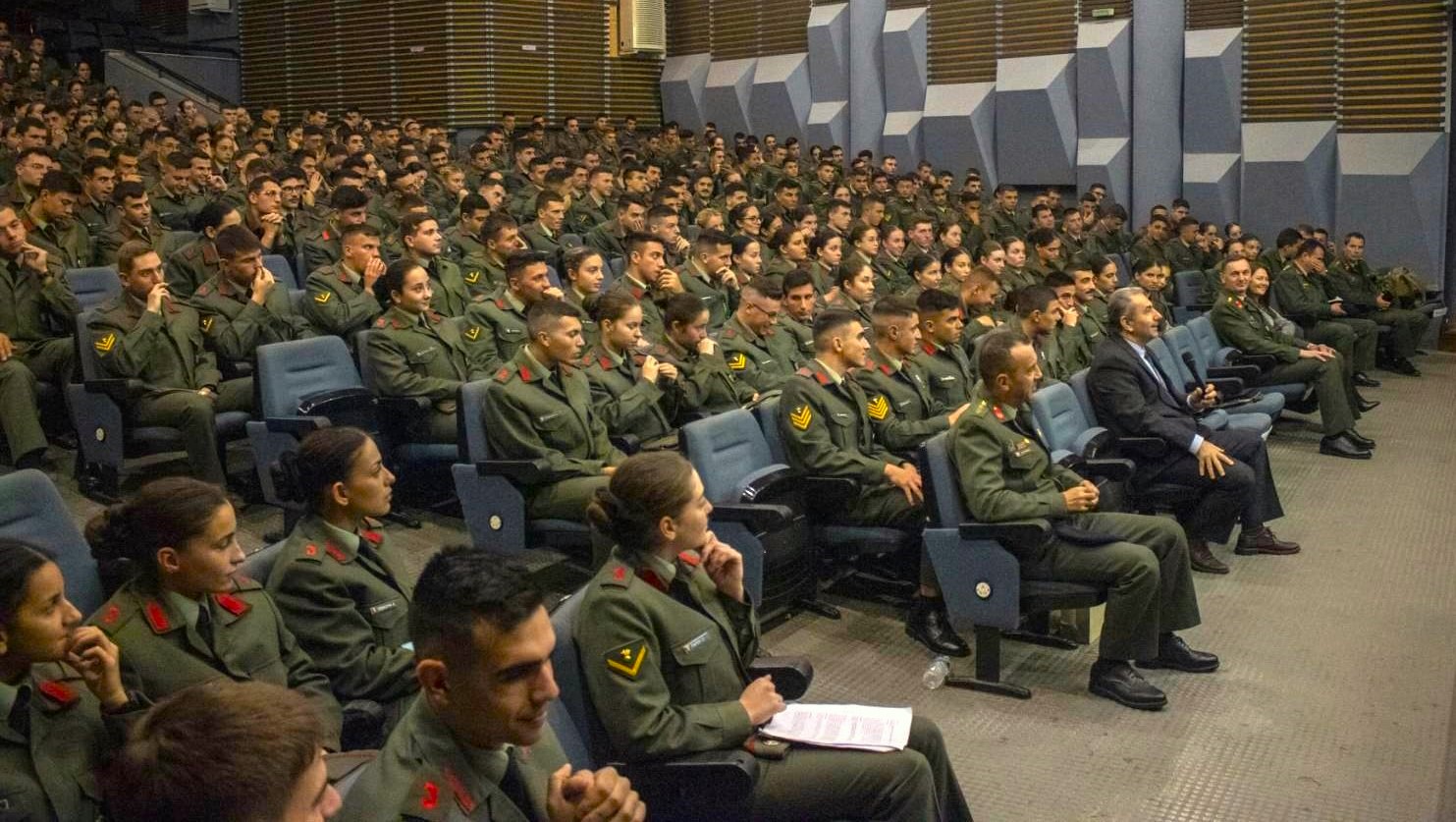
The General Director of the General Directorate of National Defence Policy and International Relations (GDNDPIR), of the Ministry of National Defence (MoD) Dr. Konstantinos Balomenos, accepting an invitation from the Commandant of the Non-Commissioned Officers School (SMY) Brigadier General Ioannis Korelis, participated as a keynote speaker in a Conference of the School on Hybrid Threats.
Specifically, on Monday, December 11, 2023, the Non-Commissioned Officers School organized a workshop at the Cultural Hall of Trikala city on “Hybrid Threats and the capabilities of the Greek Armed Forces to meet the new challenge”.
The aim of the workshop was to help participants understand Hybrid War and obtain the necessary background information in order to be able to identify it, recognise its root causes and characteristics, and assess its effects.
In addition, the ultimate goal of the SMY Command was through appropriate training, Greek NCOs to be able to deal with and manage operationally and communicatively, in a sufficient and effective way, any Hybrid Threat, combining theory and applied practice.
The thematic sessions of the workshop were:
• Theoretical background – Conceptual Definition of Hybrid Threats
• Application of International Armed Conflict Law to Hybrid Threats
• International practice of addressing and deterring Hybrid Threats
• Existing capabilities and innovative methods for the prevention and deterrence of Hybrid Threats by the Hellenic Armed Forces
The General Director of the GDNDPIR, Dr. Konstantinos Balomenos, being the main guest of the Conference, presented a lecture on “Understanding and Combating the Hybrid War. The role of the Armed Forces in the Grey Zone”.
He then attended all the lectures of the students who participated in the four sessions of the Conference and proceeded to an evaluation, while offering his scientific knowledge and technocratic experience in relation to the management and treatment of Hybrid Threats.
Dr. Konstantinos Balomenos, during his lecture, presented:
• The definition of “International Crisis”
• The conceptual definition of “Hybrid War”
• The vulnerabilities of a target that can be exploited by a hybrid actor
• The definition of “Grey Zone”
• The tools and tactics utilised by a state or non-state actor operating in the Grey Zone
• The process of addressing operations taking place in the Grey Zone
• The role of the Armed Forces in countering Hybrid Operations or Operations in the Grey Zone
In conclusion, the General Director of the GDNDPIR, Dr. Konstantinos Balomenos, at the closing of his lecture, made some useful suggestions for dealing with Hybrid Threats. In particular, he stated that:
• It is necessary to use all national power actors to counter hybrid threats. Cooperation and coordination between agencies and organisations will simultaneously lead to savings, increasing national strength and efficiency of the state in the operational field. The use of this philosophy by the state apparatus can create a modern model of holistic management of hybrid threats/crisis.
• Managers of these threats/crisis are invited to be able to fully understand the information environment. This will be achieved through a national analysis mechanism so that weaknesses and vulnerabilities can be identified, while monitoring potential opponents will lead to situational awareness.
• Deterring a hybrid actor is intended to alert him that we know, can and have the will to stop him. If he proceeds to any hostile action, he will have to pay large costs. Failure of deterrence carries the risk of leading us to coercion.
• Preparedness for an effective response to a hybrid threat/crisis requires national resilience, especially intellectually.
• The lack of a national strategy to counter hybrid threats/crisis can be addressed by formulating a related doctrine.
• Communication management of hybrid threats/crisis needs a central channel of communication through a national system, which will replicate
• the national message, in order to be able to dominate the information environment, aiming at obtaining internal and international legitimacy and ultimately the support of the national goal.
• In order to prevent operations in the Grey Zone, we need:
◦ Prevention
◦ Intelligence
◦ Situational Awareness
◦ Risk Assessment
◦ Preparedness
◦ Resilience
◦ Planning
◦ Training
◦ Political Will