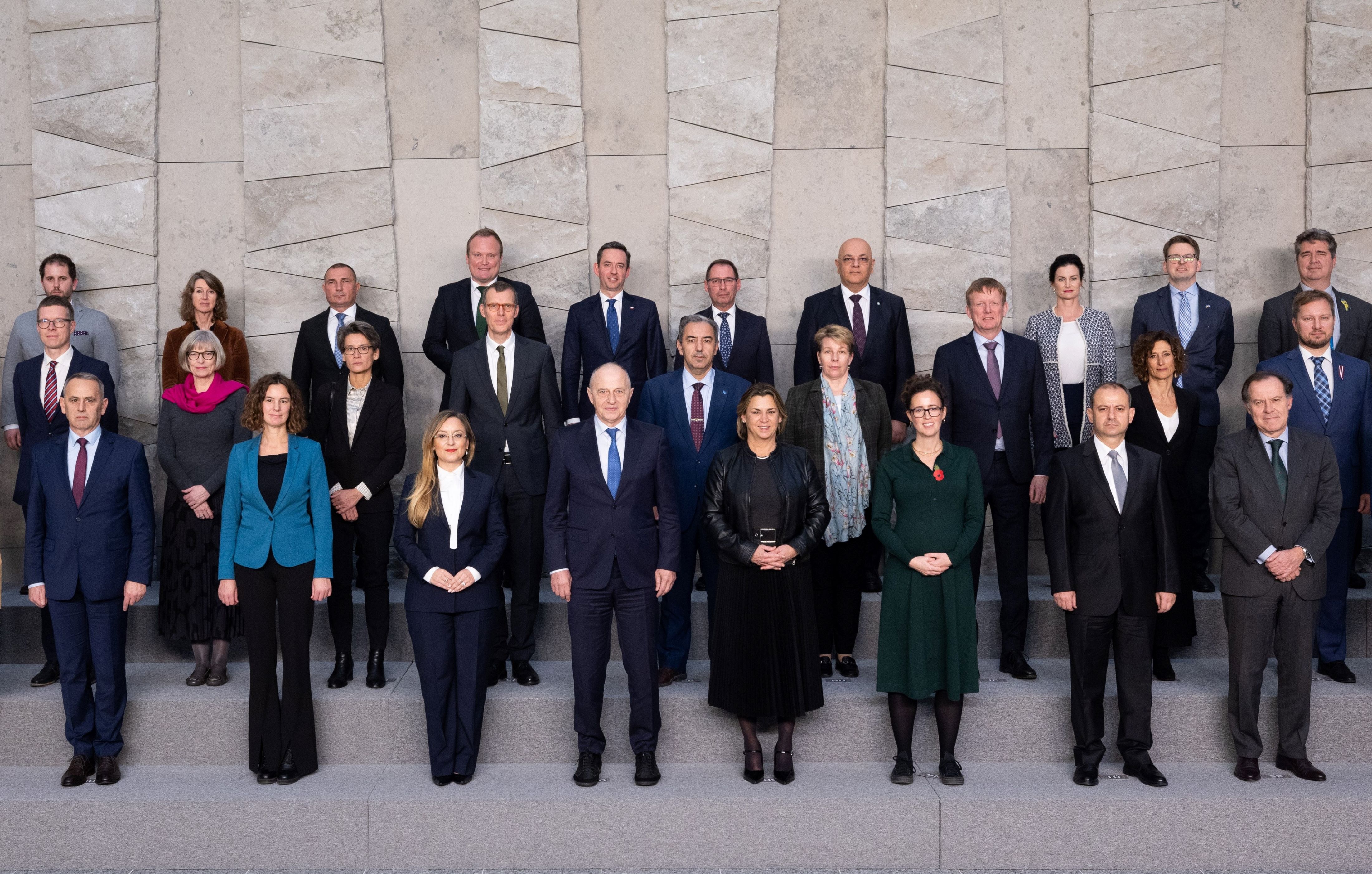
The General Director of National Defence Policy and International Relations, Dr. Konstantinos Balmenos, attended the 2nd Meeting of High-Level National Representatives of the NATO Resilience Committee, as High-Level National Representative to the NATO Resilience Committee, in response to an invitation from NATO Secretary-General Jens Stoltenberg, on Tuesday 7 November 2023 at NATO headquarters in Brussels.
NATO Secretary General Jens Stoltenberg chaired the meeting and discussed with NATO National Representatives on Resilience, the challenges related to it faced by the Euro-Atlantic region, as well as on the wider implications of Russia’s war of aggression against Ukraine.
The meeting also underlined the need for enhanced social resilience and more effective cooperation between the civil and military sectors and between governments.
In particular, Mr Stoltenberg stressed the importance of collective resilience in addressing the whole range of threats faced by NATO Member States, from pandemics and climate change to armed conflicts.
Ukraine’s Deputy Prime Minister Ms Olha Stefanishyna attended the meeting via VTC from Kiev. Addressing the Allies, she underlined the crucial role of national resilience in defence against armed attacks.
Officials of the European External Action Service also provided information on how the European Union is helping Ukraine strengthen its resilience.
In relation to the conclusions that can be drawn regarding resilience from the war in Ukraine, the General Director of National Defence Policy and International Relations (NDPIR), Dr. Konstantinos Balmmenos, during his address at the first session of the Meeting, referred to the importance of social cohesion in achieving community resilience and the necessity of inter-agency coordination.
In particular, Dr. Balomenos pointed out that social cohesion and community resilience are critical to addressing armed conflicts. Building strong social networks and trust within communities can facilitate collective action and mutual support in times of crisis. These factors can be used to ensure that responses to armed conflicts are more effective and coordinated. He also stressed that armed conflicts often require an inter-agency and comprehensive governmental approach, but also the support of society as a whole. In this context, effective coordination between the various government agencies, the military, non-governmental organisations and international partners is essential.
At the second session of the meeting, there was a discussion on how NATO can better develop its available resources to achieve a more effective and coherent implementation of the 2023 goals of the Alliance for Resilience, which were endorsed by NATO leaders at the last summit in Vilnius.
During his intervention at this session, the General Director of GDNDPIR, Dr. Balomenos, stressed that it is necessary for the Allies to assess the current capabilities and vulnerabilities of each NATO Member State. In the same context, the key challenges and risks faced by each Member State need to be identified, and the current legal and institutional framework to address these challenges and risks needs to be assessed.
Then, Dr. Balomenos stressed that NATO must clearly define the resilience goals and priorities that its Member States want to achieve, provided that these goals are aligned with the goals of each state and the nature of the challenges it faces.
In relation to the existing legal and regulatory framework, the General Director of GDNDPIR stressed that NATO Member States should review and update their legal and regulatory framework to ensure that they adequately address resilience needs. This process may include the necessity of creating new laws or regulations, amending existing ones, or eliminating obsolete provisions.
Finally, with regard to capacity building by States, Dr. Balomenos stressed that each NATO Member State should invest in the capacity building of its government officials, of the first responders, and other relevant groups involved in national resilience. In this light, each Member State should ensure that its officials have the necessary knowledge and skills to effectively address resilience challenges.