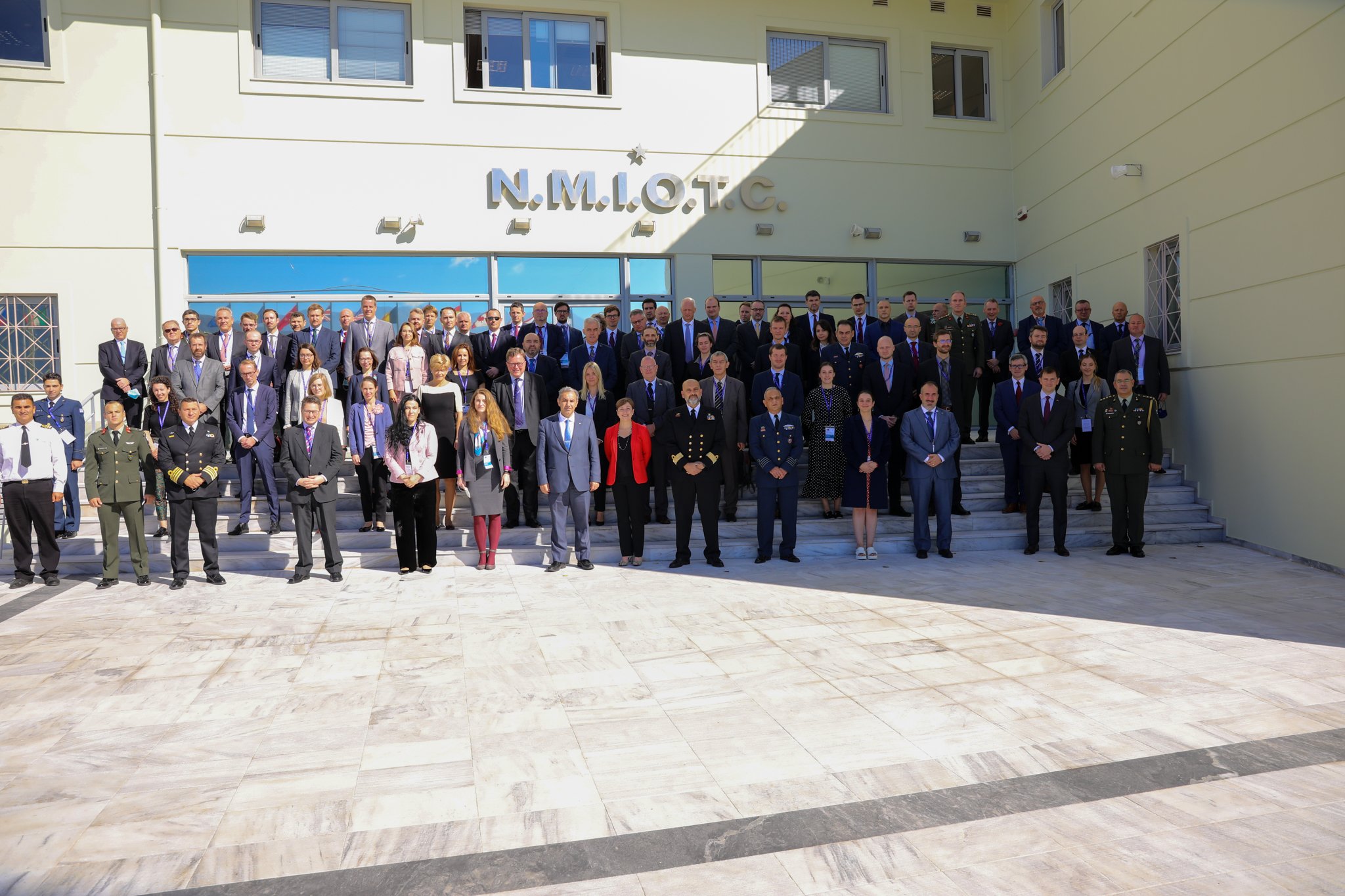
The annual proceedings of the Nuclear Policy Symposium of the Alliance (NATO Nuclear Policy Symposium 2021) were successfully completed, taking place on 3 and 4 November 2021 at the NATO Maritime Interdiction Operational Training Centre (MIOTC) in Chania.
This Symposium was co-organised by the Ministry of National Defence and NATO’s Directorate for Nuclear Policy, while its realization was undertaken by the General Directorate of National Defence Policy and International Relations of the Ministry of National Defence.
The Symposium brought together senior institutional actors, senior officials and other officials from the Ministries of Defence and Foreign Affairs of the member states of the Alliance, aiming at the exchange of views on nuclear policy, deterrence and disarmament issues.
At the opening of the Symposium on Wednesday 3 November, NATO Secretary General Jens Stoltenberg addressed an online greeting (See the greeting here) where he made it clear that the Alliance remains strong in its nuclear deterrence but must continue to adapt and enhance the credibility and effectiveness of its nuclear capabilities. Mr Stoltenberg also stressed that NATO would continue to play its part in supporting arms control, disarmament and non-proliferation efforts. “In this respect,” he said, “NATO’s goal is a world without nuclear weapons. But as long as nuclear weapons exist, it will remain a nuclear alliance”.
In addition, on the first day of the symposium’s proceedings, developments in the nuclear sector outside the Euro-Atlantic zone (North Korea, Iran, Pakistan, etc.) and their possible implications, in terms of a terrorist threat, were discussed. NATO’s main challenges to nuclear deterrence were analysed over the next decade, including developing capabilities and the evolving doctrine of China and Russia, and a distinct extensive reference was made to emerging and disruptive technologies as an important parameter of nuclear deterrence. The first day’s work was concluded by identifying the need to develop an effective communication campaign to understand and assimilate the role of nuclear deterrence in consolidating international peace and security, including the credibility of NATO’s nuclear capabilities, as well as the transparency and political will of the Member States and NATO’s allies.
On the second day of the symposium’s proceedings, the main focus of the debate was to assess what has been done to date at international level, but also to consider further initiatives on nuclear disarmament, non-proliferation and arms control, also in the light of the respective International Banning and Non-Proliferation Treaties. Finally, a discussion took place on how to strengthen the Alliance’s nuclear deterrence over the next decade, while taking into account NATO’s new “Strategic Concept”, which will guide its future political and military development.