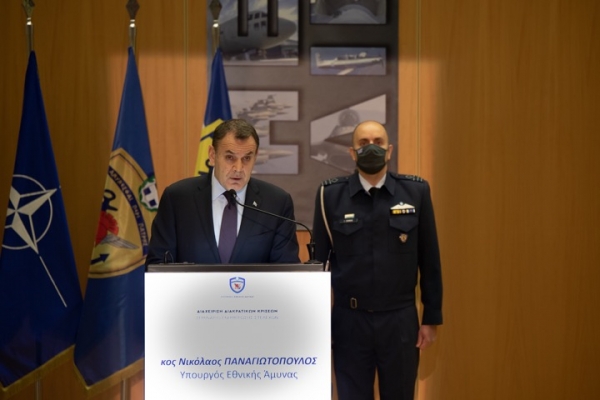
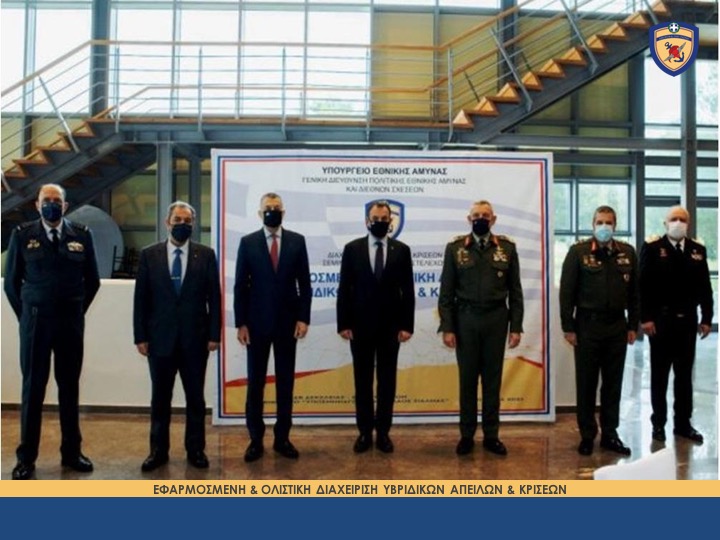
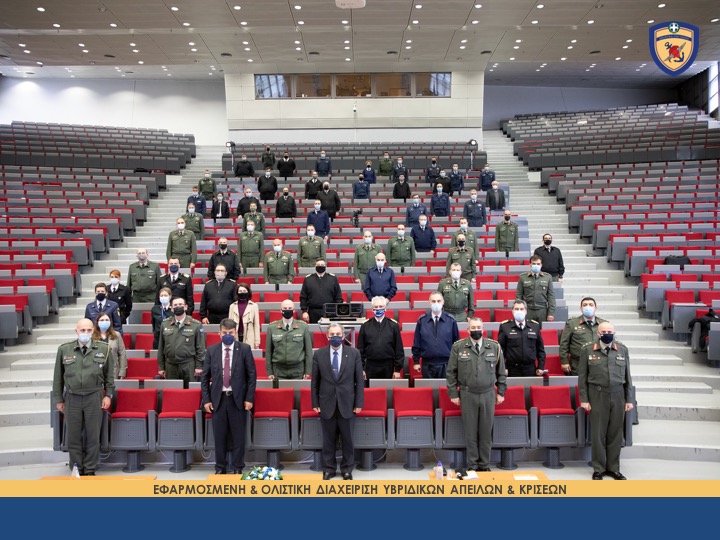
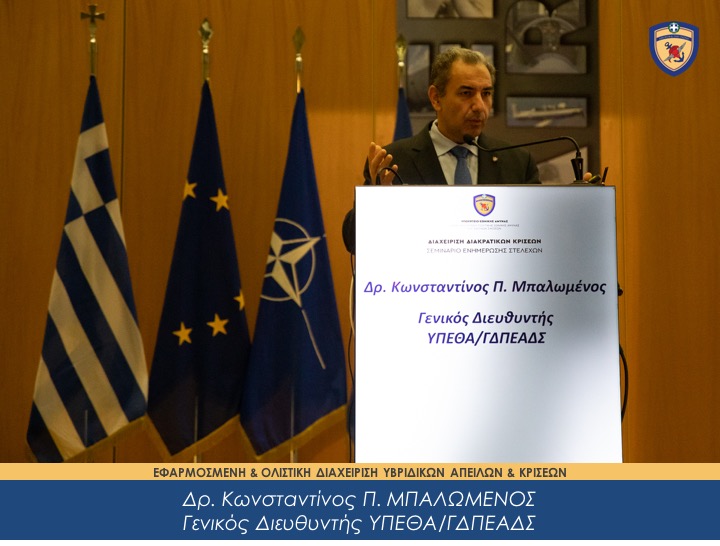
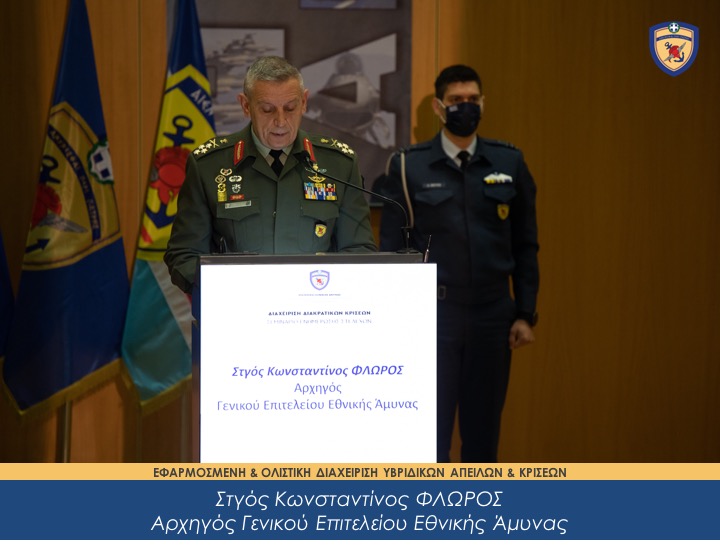
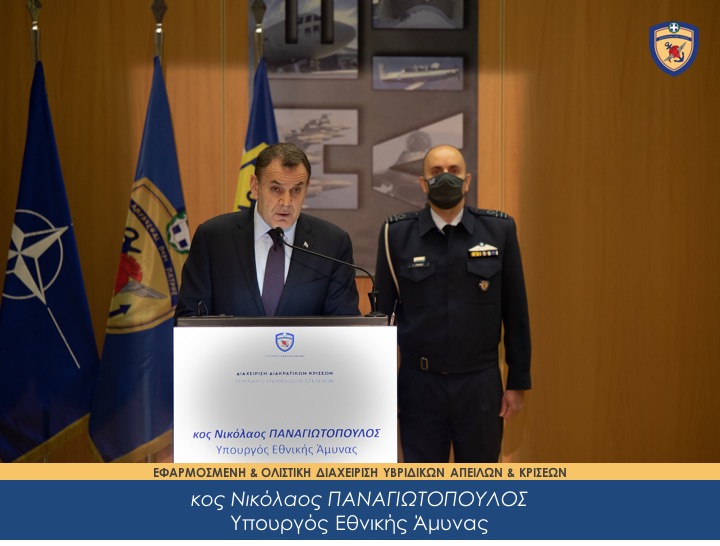
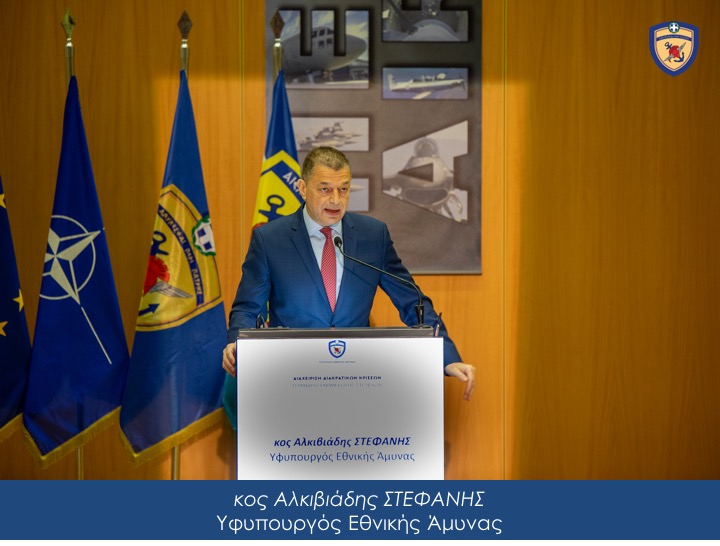
An important initiative of the General Directorate of National Defence Policy and International Relations of the Hellenic Ministry of National Defence and International Relations took place at the Air Force Academy during April with the holding of the Training Seminar for the Staff of the Armed Forces entitled “Applied and Holistic Management of Hybrid Threats and Crisis”. In addition to the staff of the three Branches of the Armed Forces, the seminar was attended by officials of co-competent state bodies.
As pointed out by the General Director of National Defence Policy and International Relations of the Hellenic Ministry of National Defence, Dr. Konstantinos Balomenos, in today’s globalised unstable and strongly competitive international environment a question of outmost importance is the effective management of hybrid threats and crises. The crisis managers involved are called upon to put in place an appropriate management mechanism to enable them to cope with uncertainty, confusion, chaos, insecurity, rapid evolving situations and multiple pressures of the national system during the development and culmination phase of a hybrid threat/crisis.
On this basis, the aim of the seminar was to bring together decision-makers involved in national crisis management, executives implementing these decisions at operational level, as well as experts and academics involved in the study and analysis of hybrid threats/crisis and at the same time inform and train participants in the field of holistic hybrid threats and crisis management.
In this light, previous hybrid threats and crises were thoroughly studied, at national and international level, useful conclusions were drawn from their management, the effectiveness of crisis management mechanisms was assessed and proposals were made to modernise and strengthen the resilience of the existing national mechanism in Greece.
During the seminar, issues of risk management, leadership, management and decision-making, operational and communication crisis management and strategic communication in crisis management were developed.
In particular, the participants had the opportunity to understand the phenomenon of the crisis, to acquire the necessary background in order to be able to identify it, to recognise its production causes and its specific characteristics, to distinguish the stages of its development and ultimately to assess its effects.
The aim of the Seminar was also to prepare the participants so that they could deal with and manage operationally and communicatively, with efficiency and effectiveness, any crisis or emergency, combining theory and applied practice. In this context and in order to achieve the above objective, the importance of operational and communication management through targeted lectures, tailored workshops and case studies was developed among the participants of the Seminar.
At the same time, this seminar sought to help participants understand the way public diplomacy and media work, and the degree of importance of their role in the crisis and emergency response process.
In addition, the aim of the Seminar was the comprehension by the participants of the methods used for the communication management and exploitation of Mass Communication Media, by crisis managers to communicate with their special audiences (stakeholders) and public opinion in general.
From this perspective, participants tried to acquire the necessary theoretical background to enable them to understand adequately the philosophy and rules governing the operation of the Media Media, the mechanism for producing news, the news framework process, the process of shaping the thematic agenda, and the role of journalists in influencing public opinion.
Finally, it was sought to prepare the participants in order to be able to effectively address the entire spectrum of this management in the course of a crisis and to highlight the importance of the “Whole of Government Approach” model of holistic crisis management.
Useful conclusions were drawn from the seminar’s work, and in particular, it was highlighted:
a. The need to institutionalise the conduct of the seminar in question on an annual basis.
B. The importance of implementing a holistic model for managing and responding to threats and crises, especially now that they have asymmetrical characteristics and a form of hybrid character.
C. The need to involve NATO officials, the European Union and allied states who will participate in the decision-making centres in the management of an international crisis, in order to develop a common culture in response to crises and emergencies through a fruitful operational and scientific dialogue, as well as the synergies that will be put in place.
D. The need to create an observatory that will focus on the study of hybrid threats and crises both inside and outside Greece and the Eastern Mediterranean in general, as part of a holistic crisis management mechanism.