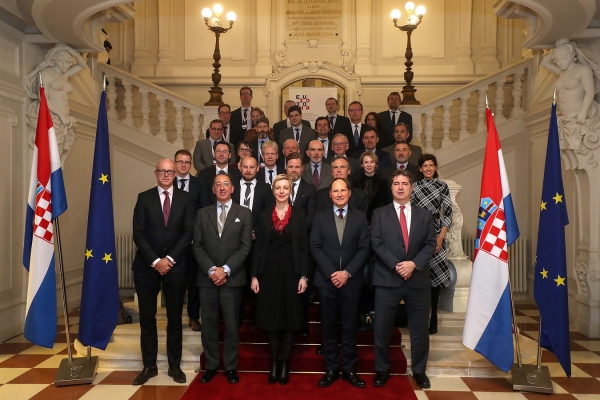
In the framework of the Croatian Presidency of the Council of the EU, important discussions on the development of the Permanent Structured Cooperation (PESCO), the climate change, but also the relations between the EU and NATO were held during the scheduled meeting between the EU Defence Policy Directors which took place in Zagreb, on the 23rd of January 2020. The Greek General Director of National Defence Policy and International Relations, Dr. Konstantinos Balomenos, took part in the meeting, together with lieutenant Konstantinos Tzanetakos, officer of the EU affairs department of the Hellenic MoD.
The previous evening before the Working Sessions, an informal discussion was held on the strategic direction of the EU regarding defence and security matters, on the basis of a “strategic compass”, during which the General Director stressed the importance of developing a common threat assessment and of maintening the European Level of Ambition.
At the first Working Session, the strategic revision of PESCO was discussed. In its intervention, the General Director particularly highlighted the question of addressing new security challenges through the engagements within PESCO, while stressing the need for coherence in defence initiatives, with a view to safeguarding the security of the EU and its citizens.
At the second Working Session, the subject of the debate was the relationship between climate change and defence. In his intervention, the General Director stressed the seriousness of the situation, characterized climate change as a “threat multiplier”, and highlighted the role of the European Defence Agency as a catalyst in the effort to reduce the European energy footprint, thanks to the latter’s know-how.
Finally, at the third Working Session, relating to the EU-NATO relations on hybrid threats, where the Assistant SG for Defence Policy and Planning of NATO, Mr. Patrick Turner, participated, the General Director recognized the consistently positive and constructive EU-NATO cooperation in this area, while stressing that any cooperation should be based on the principles of “non-exclusiveness”, transparency, reciprocity and the autonomy of each organization in the decision-making process.