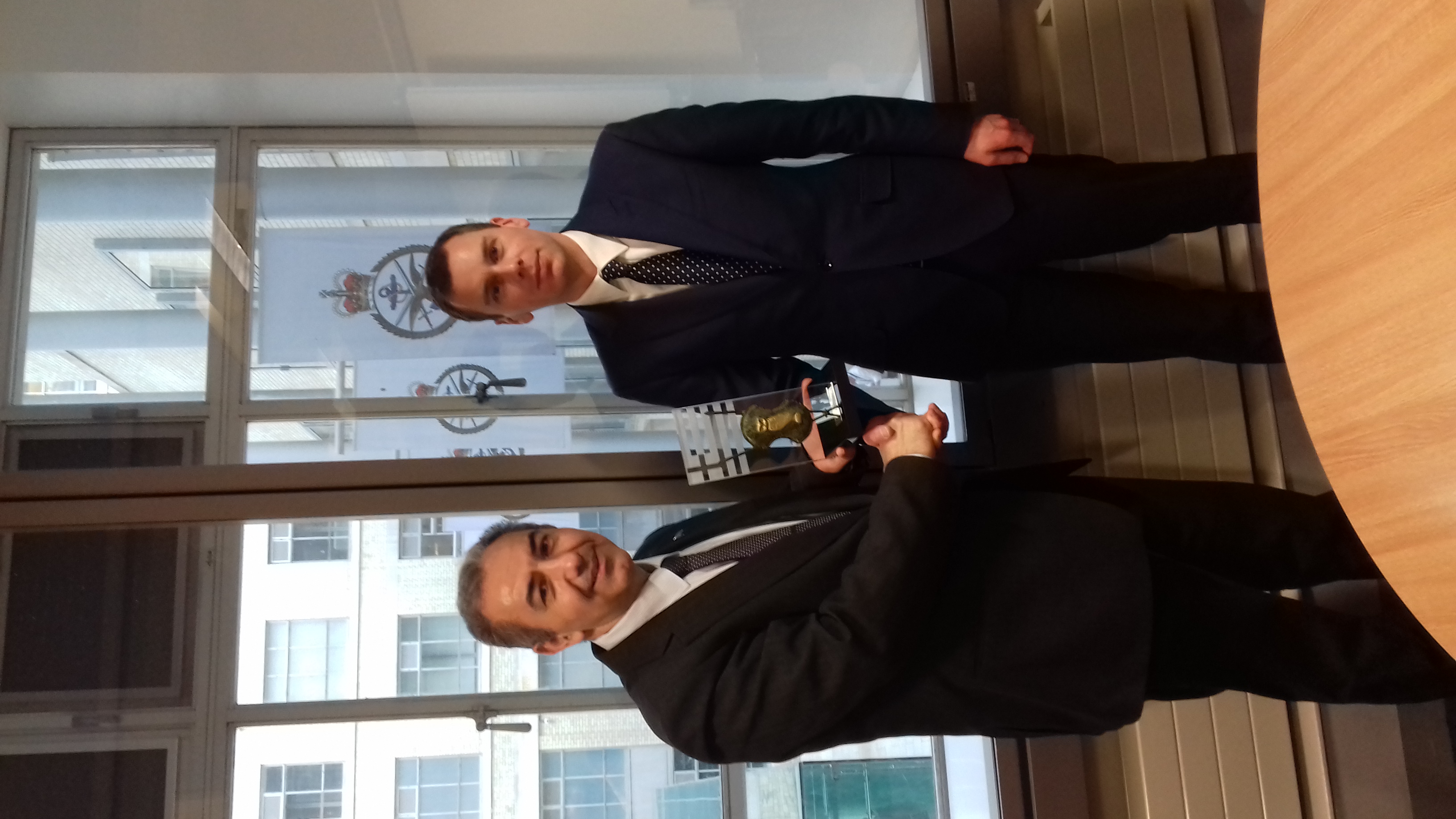
The General Director of the General Directorate of National Defence Policy and International Relations (GDNDPIR), of the Ministry of National Defence, Dr. Konstantinos Balomenos, in the context of the deepening of Greek-UK bilateral defence relations, held a working meeting in London on Monday 30 January 2023 with the Head of Europe and Canada, in the UK Ministry of Defence’s Directorate of Euro-Atlantic Security of the UK Ministry of Defence, Mr Sebastian Carr, at his invitation.
During the meeting, issues of mutual interest were discussed, such as the impact of Russia’s invasion of Ukraine on the broader geopolitical environment, the security situation in Western Balkans, security challenges and threats in the wider Eastern Mediterranean, the Middle East and North Africa (MENA) environment, the NATO Strategic Concept, the strengthening of EU-NATO cooperation, as well as the deepening of relations and bilateral defence cooperation between the two countries.
In relation to the situation in Ukraine, Dr. Balomenos condemned Russia’s revisionist actions addressed against Ukraine’s territorial integrity, sovereignty and independence and stressed that Greece will continue to fully implement the sanctions decided by its allies against Russia. In response to Ukraine’s request, Greece has sent significant military equipment and humanitarian aid, consisting of medical supplies and materials, while hosting thousands of Ukrainian refugees.
For his part, Mr Sebastian Carr, after referring to the significant assistance the United Kingdom has provided to Ukraine, stressed the need to support Ukraine so that Russia’s expansionist policy would fail at all costs. Finally, both directors agreed that the war in Ukraine has created an unstable environment in the wider Eastern European region, which the European Union (EU) and NATO have an obligation to deal with.
On the security situation in Western Balkans, both Dr Balomenos and Mr Carr agreed that despite the fact that Western Balkans are of strategic importance, they continue to face multifaceted challenges stemming from both internal weaknesses and malicious influence, as well as hybrid activities of external actors. In addition, ethnocentric tendencies, tensions, and revisionism have become more intense throughout the region in recent years. In particular, Dr. Balomenos stressed that Greece is a strong supporter of the European perspective of the Western Balkan states, which is a strategic goal, as well as an important tool for promoting democracy, the rule of law and respect for fundamental human rights in the wider region. For his part, Mr Sebastian Carr pointed out that the Western Balkan region is of the utmost importance for the UK, and given that, in the near future, UK will intensify its presence and action in the region.
With regard to security challenges and threats in the wider Eastern Mediterranean, Middle East and North Africa (MENA) environment, the General Director of National Defence Policy and International Relations pointed out that NATO should not only focus on Eastern Europe and Russia’s threat, but also turn its attention to the southern flank of the Alliance, because it faces major threats, such as illegal migration, hybrid threats and terrorism. In addition, Dr. Balomenos, briefly referred to the current security situation in Eastern Mediterranean, the challenges and risks in the wider region (instrumentalisation of migration, border security, etc.) and finally addressed Türkiye’s strategy, which, through its revisionist and extreme dangerous action, constitutes the main destabilising factor both in Eastern Mediterranean and within NATO (e.g. the delay in the accession process of Sweden and Finland in the Alliance).
In this context, Mr Sebastian Carr recognized the problems posed by Türkiye’s irrational action, criticised its stance of close — particular relations with Russia, and finally expressed hope that, following the Turkish elections, there would be stability within Türkiye so that there would be no deterioration of the situation in Iraq, Syria and Libya.
In relation to the role of NATO, Dr. Balomenos pointed out that in view of the current instability in the international system and of the strategic competition between states, NATO should continue to ensure freedom, security and prosperity in the Euro-Atlantic area. For this reason, its defence capabilities should be strengthened and its resilience increased. In order to address future challenges and threats, it is necessary to enhance partnership between the EU and NATO with the view of achieving the best use of their resources and capabilities.
For his part, the Head of Europe and Canada, in the UK Ministry of Defence’s Directorate of Euro-Atlantic Security of the UK Department of Defence agreed on this point of view, noting the need to avoid duplications in the actions and policies of the two organisations.
Regarding the cooperation between Greece and the United Kingdom within NATO, both interlocutors stressed the need for further cooperation between the two countries to ensure that NATO remains the cornerstone of Euro-Atlantic security and underlined that the two countries should contribute together to strengthening Europe’s resilience to security threats and hybrid threats.
Finally, as far as the deepening of bilateral defence relations and cooperation is concerned, Dr. Konstantinos Balomenos and Mr Sebastian Carr, taking into account the Joint Vision of both countries on defence and security, agreed on an Action Plan — covering joint actions at political and operational level — to be sealed with the signing of a relevant Memorandum of Understanding (MoU).