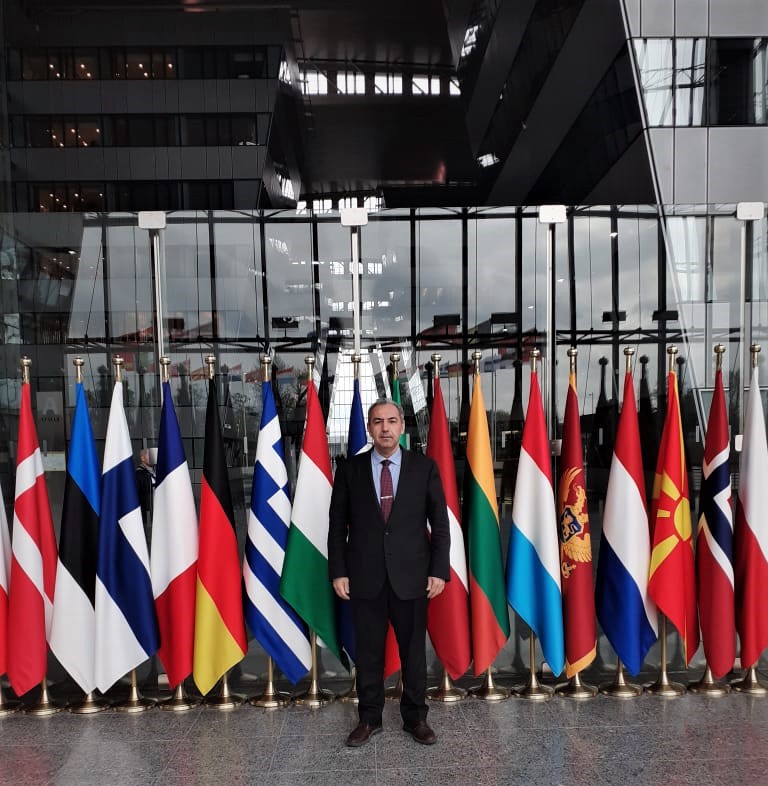
The General Director of National Defence Policy and International Relations (GDNDPIR) of the Ministry of National Defence (MoD) Dr. Konstantinos Balomenos, participated in the Meeting of the Defence Policy Directors of NATO member states, held in Brussels, on the 19th and 20th April 2023. The key issues discussed were the implications of the war conflict in Ukraine, the implementation aspects of the new baseline of the Alliance’s deterrent and defence provision, ahead of the upcoming summit in Vilnius (10-12 July 2023), as well as the strategic messages of the deliverables of the present Conference on deterrence and defence.
In the context of the debate on Ukraine, Dr. Konstantinos Balomenos referred to the dramatic deterioration of the living conditions of the population, with the aim of reducing the Ukrainian resistance and causing a new refugee wave. At this point, he referred to the humanitarian crisis experienced by Greek expatriates, especially those in the eastern provinces of Ukraine who are forced to live in the midst of war operations. He stressed Greece’s commitment to contribute to the reconstruction of Ukraine when the war is over and assured its counterparts that Greece will continue to support Ukraine at all levels: political, economic, military and humanitarian, for as long as necessary.
In the context of the discussion on the implementation of the new baseline of NATO’s deterrent and defence provision, Dr. Balmenos referred to our country’s contribution to strengthening NATO’s deterrence and defence, having already provided 2 high-ready Allied Multinational Maritime HQ-South-East (AMM-SE HQ) and Maritime Force HQ (GRMARFOR HQ) high-readiness headquarters, the second of which has already been in an Initial Operational Capability (IOC) state since November 14, 2022. In addition, he highlighted the strategic importance of Alexandroupolis for the activation of operational capabilities in the Alliance’s eastern wing, considering that the survivability of allied forces depends on the reliability of a resilient and efficient fuel network. In this context, Greece stands ready to support the expansion of the NATO Fuel Supply Chain through Alexandroupolis, in support of the developed Allied forces in the eastern wing.
Dr Balomenos referring to the strategic messages of the Alliance’s deterrence and defence provision, stressed the need to strongly convey the message to the societies of NATO member states that the Alliance will provide in a credible and stable way the required security based on its defence capabilities, while it is required to convince allies, partners and the international audience about the policies, actions and values underlying NATO. He also supported the possibility of countering the impact of rival disinformation activities aimed at both the Allies’ internal audience and the corresponding international audience, highlighting the coherence and unity that should characterise NATO decisions, based on the fundamental principles of the Alliance and international law.
Finally, during the last part of the meeting, where the issues of deterrence and defence of the Alliance following the Vilnius Summit were discussed, Dr. Balomenos supported the ability to address all risks — threats to the Alliance (a 360 degree approach), taking due account of the risks emerging in the South, not just in the eastern wing. In addition, he supported cooperation with the European Union, which can complement NATO and in a way beneficial for peace and security in Europe, as well as with NATO partners in the Asia-Pacific region, taking into account China’s presence and the role it claims in the world. He also highlighted the current security challenges in the areas of Cyberspace, electromagnetic spectrum, space, ultrasonic systems and quantum technology, and made particular reference to the importance of collective resilience within the Alliance, in order to promote situational awareness and consultation in order to identify and mitigate critical infrastructure vulnerabilities and dependencies.