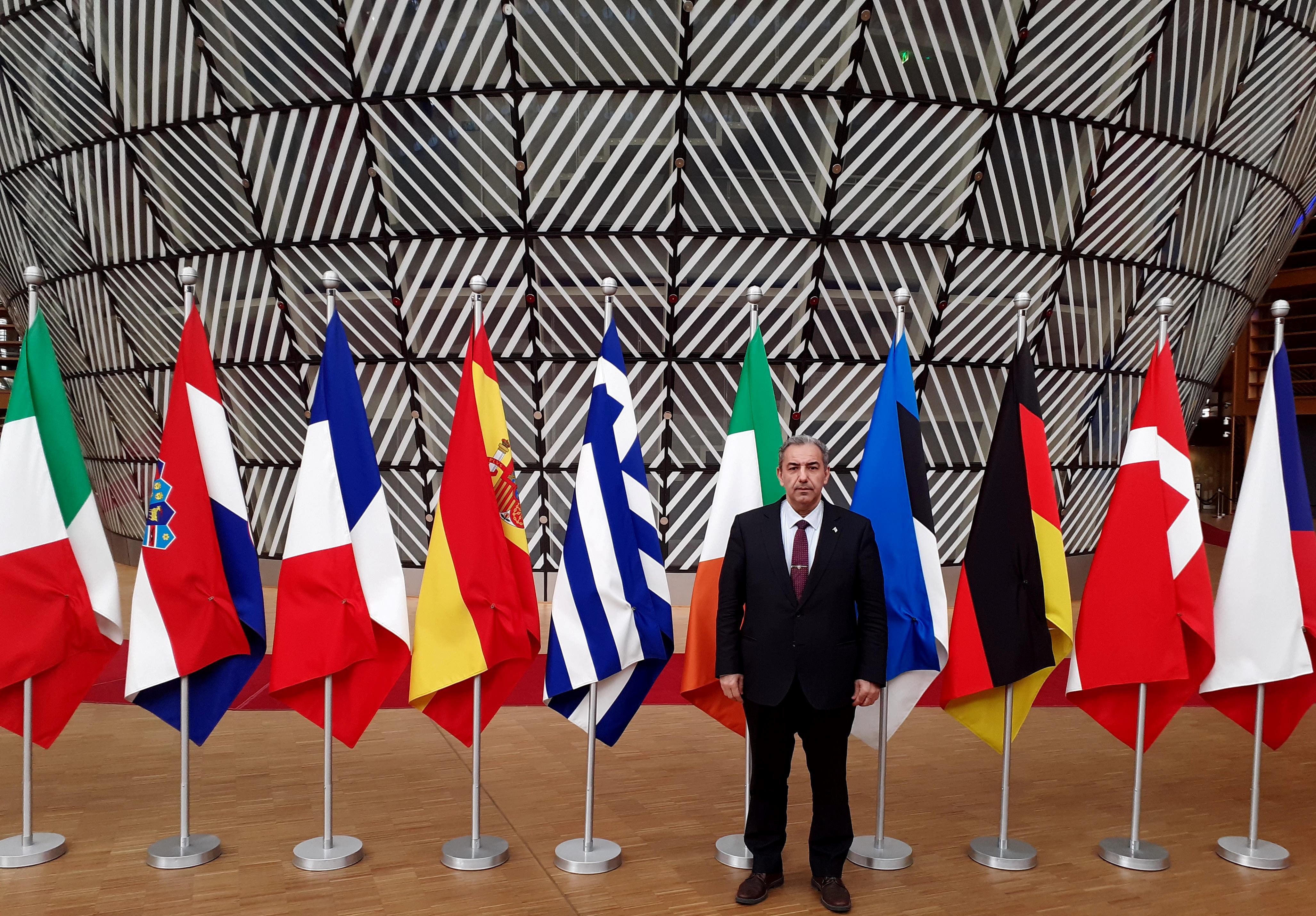
The General Director of National Defence Policy & International Relations (GDNDPIR) of the Ministry of National Defence (MoD) Dr. Konstantinos Balomenos participated in the meeting of the General Directors for Defence Policy of the European Union (EU) held in Brussels on 27 April 2023. The work of the Meeting focused on the developments in Ukraine and the role of the EU, as well as on the means to build European resilience against hybrid threats.
In his intervention, Dr. Balomenos first confirmed Greece’s commitment to continue to provide support to Ukraine, both bilaterally and at EU level, through assistance to the Military Assistance Mission (EUMAM Ukraine) and participation in relevant EU initiatives.
He highlighted the value of the European Peace Facility (EPF) as an important tool for supporting Ukraine and the Common Security and Defence Policy (CSDP). Addressing his counterparts, the General Director underlined as self-evident that the principle of transparency and the implementing rules of the Facility, including the rules of origin of the equipment provided, should be fully respected.
Dr. Balomenos also referred to the possibility of Türkiye’s participation in the EPF mechanism, stressing: “We place particular emphasis on transparency and the EPF’s agreed implementing rules. It is clear that funding through the Facility of economic operators controlled by third countries that threaten the security interests of Member States cannot be accepted” ; and thanked the Swedish Presidency for its efforts to reach an agreement on the issue of joint procurement, while taking into account the concerns of all Member States.
As regards the European Defence Technological and Industrial Base, Dr. Balomenos stated that restoring sufficient industrial capacity should be a key priority for building a credible defence capability. Production-oriented and realistic approaches are necessary to ensure that systems and ammunition are produced at an adequate pace, ideally, in line with the ability to react to short peak phases of demand.
Finally, he thanked his counterparts from Italy, France and the Netherlands for the valuable contribution of their countries to the evacuation of Greek citizens from Sudan.
During the working lunch, in which representatives of NATO and the European Centre of Excellence for Hybrid Threats (Hybrid CoE) participated, the General Director of National Defence Policy and International Relations called for a focus on hybrid threats, highlighting their horizontal and cross-border nature. He raised extensively the issue of the instrumentalisation of migration as an abominable hybrid threat aiming at the cynical promotion of political goals through the use of people, an act which violates fundamental European values and principles, while he recalled Greece’s special location as a member state located at the EU’s external borders.
During the discussion that followed, he put on the table his reflection on the need for a mechanism that recognises and conceives hybrid threats in an common manner, a mechanism which will form a prerequisite for the timely and effective response of national and EU’s crisis response mechanisms.
In the margins of the meeting, the General Director, Dr. Balomenos held a working meeting with the Greek Representative to the Political and Security Committee (PSC), Ambassador Ms Vassiliki Gounari, during which Common Security and Defence Policy issues were discussed.